
ELASTIC and 6G-PATH Explore Intelligent Orchestration across the Edge–Cloud Continuum
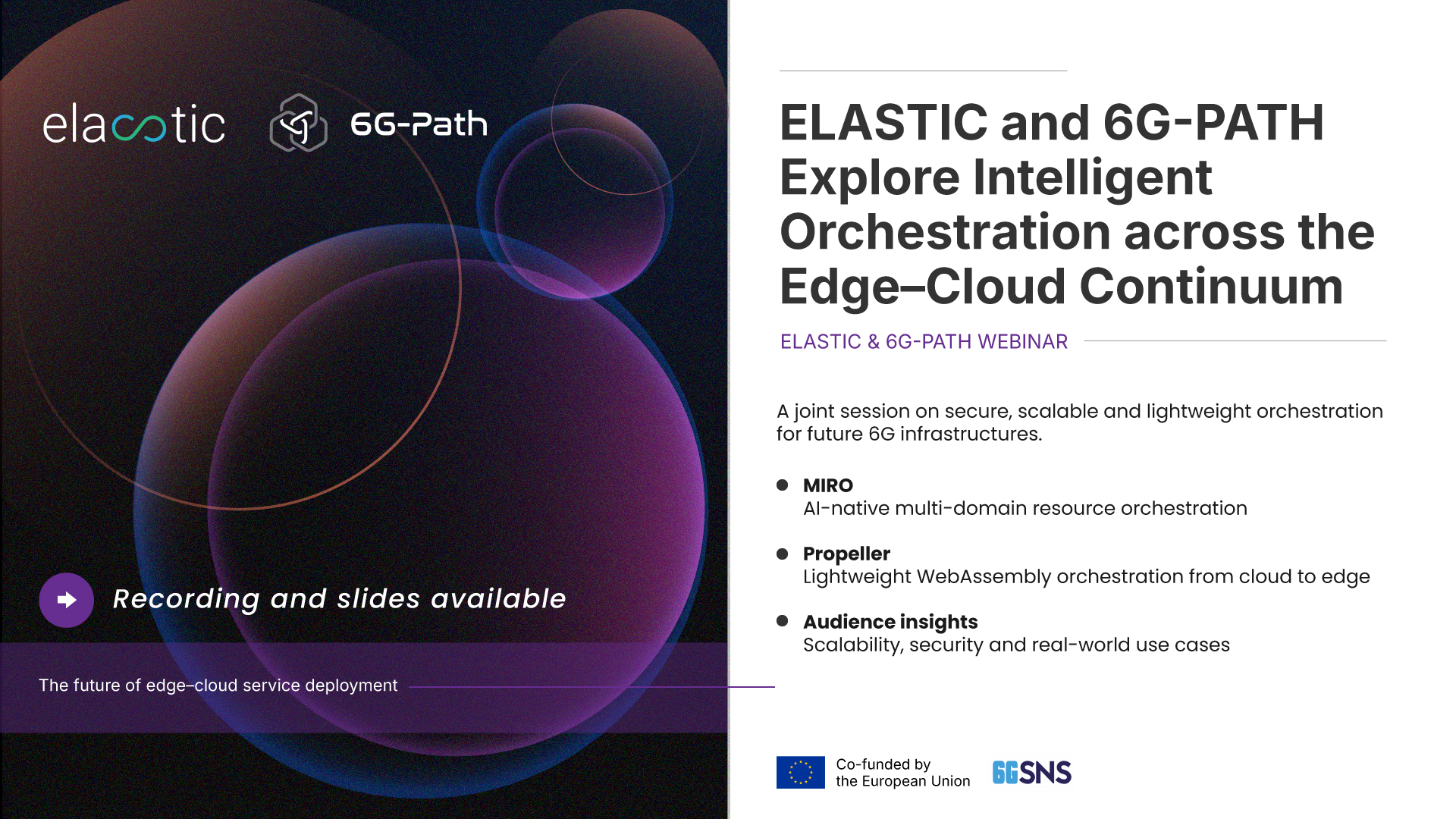
On 2 April 2026, the ELASTIC and 6G-PATH projects jointly organised the webinar “Intelligent Orchestration across the Edge–Cloud Continuum”, bringing together stakeholders from the 6G, edge–cloud, orchestration, research, and innovation communities.
The webinar focused on one of the key challenges of future digital infrastructures: how to efficiently, securely, and intelligently deploy and manage services across increasingly distributed and heterogeneous environments, from cloud infrastructures and edge nodes to far-edge and IoT devices.
As 6G systems evolve, service deployment will need to become more dynamic, adaptive, and resource-aware. Future applications will rely on orchestration frameworks capable of operating across multiple domains, supporting low-latency execution, efficient resource allocation, automation, trust, and security. Against this background, the webinar presented complementary approaches from the ELASTIC and 6G-PATH SNS JU projects.
A Joint Perspective from Two SNS JU Projects
The session opened with an introduction to the collaboration between ELASTIC and 6G-PATH, highlighting the common challenges addressed by both projects in the area of edge–cloud orchestration.
The 6G-PATH project was presented by Prof. Tarik Taleb, who introduced its work on 6G pilots and trials across Europe. The project supports experimentation and validation through use cases, testbeds, pilot sites, and open calls, aiming to foster the development and testing of technologies for future 6G systems.
The ELASTIC project was presented by Dr. Dhouha Ayed, who introduced the project’s mission, objectives, architecture, key technologies, and demonstrators. ELASTIC focuses on secure, portable, and efficient orchestration across the cloud–fog–edge continuum, combining technologies such as WebAssembly, confidential computing, eBPF, remote attestation, and lightweight orchestration.
Together, the two projects offer complementary perspectives on how future 6G infrastructures can support secure, scalable, and adaptable service deployment across complex distributed environments.
MIRO: AI-Native Multi-Domain Intelligent Resource Orchestration
A key part of the webinar focused on MIRO – Multi-Domain Intelligent Resource Orchestration, presented by Prof. Tarik Taleb in the context of 6G-PATH.
MIRO is an AI-native orchestration framework designed to support intelligent resource and service management across complex multi-domain environments. It addresses the need for orchestration mechanisms that can dynamically manage distributed services, monitor infrastructure conditions, and support automated decision-making across the edge–cloud continuum.
By integrating AI-driven analytics and decision-making into the orchestration process, MIRO aims to support more autonomous, adaptive, and efficient deployment of services. This is particularly relevant for emerging 6G use cases that require low latency, scalability, efficient resource utilisation, and reliable operation across heterogeneous infrastructures.
ELASTIC: Secure and Portable Orchestration for Future 6G Services
The ELASTIC project overview highlighted the importance of combining efficiency, portability, and security in future service orchestration frameworks.
ELASTIC addresses several challenges that are central to 6G and edge–cloud environments, including lightweight executable isolation, secure serverless orchestration, privacy-preserving confidential computing, and workload distribution across constrained far-edge and IoT devices.
The project builds on modern cloud-native and security technologies to enable trustworthy service deployment across heterogeneous infrastructures. WebAssembly supports lightweight and portable execution, confidential computing enables secure processing of sensitive workloads, eBPF contributes to observability and performance monitoring, and remote attestation supports trust establishment before workload deployment.
Through its demonstrators, ELASTIC aims to validate these technologies in realistic scenarios and contribute to secure and efficient service orchestration for future 6G systems.
Propeller: Lightweight WebAssembly Orchestration from Cloud to Microcontrollers
The final technical presentation was delivered by Drasko Draskovic from Abstract Machines, focusing on Propeller, a lightweight WebAssembly-based orchestrator developed in the context of ELASTIC.
Propeller addresses the challenge of deploying workloads across highly heterogeneous environments, from cloud infrastructure to edge devices and constrained microcontrollers. In such environments, traditional container-based approaches may be too heavy, especially for resource-limited devices.
By using WebAssembly, Propeller enables portable and lightweight workload execution across the cloud–edge continuum. The presentation highlighted capabilities such as unified orchestration, job management, live log streaming, deployment topology management, and execution across constrained environments.
This approach supports ELASTIC’s broader vision of enabling secure, portable, and efficient orchestration across the full continuum, including far-edge and IoT environments.
Audience Insights: Scalability, Security, and Real-World Use Cases Matter Most
The webinar included interactive polls that provided useful insights into the audience’s background, interests, and priorities.
The results showed that the webinar attracted a technically engaged audience, with strong representation from academia and research, which accounted for 62% of respondents. SMEs and startups were also well represented, accounting for 24%, highlighting the relevance of the topic for both research and innovation-oriented communities.
In terms of technical familiarity, participants most frequently indicated 6G and next-generation networks as their main area of expertise, selected by 38% of respondents. This was followed by lightweight orchestration, including microservices and WebAssembly, at 27%, edge–cloud orchestration at 19%, and AI-driven orchestration at 15%.
When asked about the biggest challenges in orchestrating edge–cloud environments, scalability emerged as the leading concern, selected by 32% of respondents. This was followed closely by security at 28%, interoperability at 24%, and automation and intelligence at 16%.
These results confirm the relevance of both ELASTIC and 6G-PATH, which address the need for orchestration frameworks capable of operating efficiently across distributed, heterogeneous, and security-sensitive infrastructures.
The polls also showed strong interest in future follow-up topics. Use cases and real-world applications were selected by 50% of respondents as the area they would like to hear more about, followed by technical implementation at 31%, results and performance at 12%, and solution architecture at 8%.
This underlines the importance of connecting research outcomes with practical validation, demonstrators, testbeds, and future deployment scenarios.
Overall, the webinar was very positively received, with 96% of respondents rating it as useful or very useful. This feedback confirms the value of continued collaboration between ELASTIC and 6G-PATH on intelligent orchestration across the edge–cloud continuum.
Joint Discussion and Future Directions
The webinar concluded with an interactive discussion and Q&A session, bringing together perspectives from ELASTIC and 6G-PATH on the future of intelligent, lightweight, and secure orchestration across the edge–cloud continuum.
Several important themes emerged from the discussion, including the balance between centralised and distributed orchestration, the role of AI in orchestration decision-making, the need to manage cloud resources efficiently, and the importance of avoiding unnecessary infrastructure costs. The discussion highlighted that orchestration frameworks should not only support advanced service deployment, but also help optimise resource usage, reduce energy consumption, and improve operational efficiency.
The speakers also reflected on the poll results, noting the importance of scalability, security, and interoperability as central challenges in edge–cloud orchestration. These challenges are particularly relevant for environments that combine cloud platforms, edge nodes, IoT devices, IT/OT systems, and emerging 6G infrastructures.
The session confirmed the value of collaboration between ELASTIC and 6G-PATH. Future directions discussed included continued technical exchange, possible joint scientific work, and further exploration of how ELASTIC technologies could be adopted or tested in the context of 6G-PATH activities.
The webinar therefore marked an important first step in strengthening collaboration between the two projects and identifying concrete areas where their technologies, expertise, and communities can complement each other.
Recording and Presentations
The webinar recording is available on YouTube:
https://youtu.be/ZwG5vOMf0LI?si=TnP7dEjY0mT_6uSK
The presentation slides are available on Zenodo: https://doi.org/10.5281/zenodo.20303858
Acknowledgement
The ELASTIC and 6G-PATH projects have received funding from the Smart Networks and Services Joint Undertaking (SNS JU) under the European Union’s Horizon Europe research and innovation programme under Grant Agreement Nos. 101139067 and 101139172, respectively.